5 things an in-home visit can do for you

Learn all the ways your health can benefit when a provider comes to you.
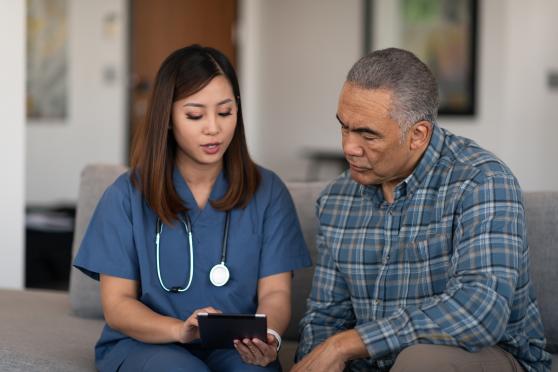
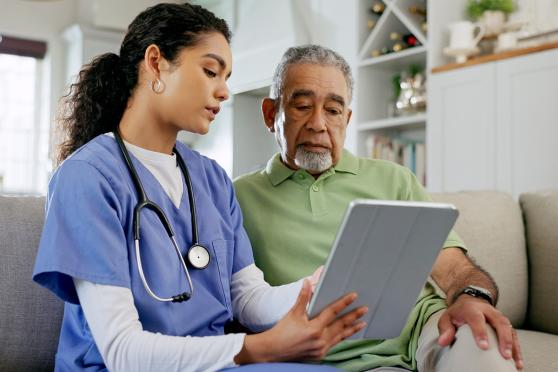
When you think of a checkup, you probably imagine a provider measuring your blood pressure and your heart rate. Maybe they also go over your medications and talk to you about a healthy diet. And chances are, you’re picturing this all happening in a doctor’s office exam room. But guess what? You can also get a comprehensive health assessment right in the comfort of your own home — at your kitchen table or in your living room.
This free, annual health review by a clinician helps keep your health on track. And it gives your primary care provider (PCP) an extra set of eyes and ears to help you get the best care. What’s more, many health insurance plans, including Medicare, cover these visits at no additional cost.
The 5 benefits of an in-home checkup
What’s so great about in-home health assessments? They can be a convenient way to stay on track with your health.
There’s a lot of information we can obtain while seeing a patient in the home setting versus in the office or in the hospital, says Paul Chiang, MD, senior medical and practice adviser for the Home Centered Care Institute. What we see and observe at home offers deep insights into the lives and the health of our patients, he says.
Curious about this new version of the old-fashioned house call? Dr. Chiang explains five big benefits:
1. You can stay up to date on important health screenings.
These may include screenings such as:
- Heart rate (pulse)
- Blood pressure levels
- Height and weight
Health professionals, such as nurse practitioners and physician assistants, may also perform simple blood tests to check for chronic conditions such as diabetes or high cholesterol. They may also provide a colon cancer screening, primarily in the form of a stool test. After an in-home assessment, your primary care doctor may follow up to recommend further testing. For example, this may include bone density scans, colonoscopies, and mammograms.

Are you as healthy as you think you are?
Your no-cost in-home health assessment can bring peace of mind.
2. You can review all your medications and supplements.
If you were heading to a doctor’s office, you’d have to write down the prescription names and numbers of your medications, as well as all the info about any supplements or over-the-counter drugs you take. Or you’d need to collect all the bottles to take with you in a bag. But an in-home provider makes it easier by looking over the medications you have right at home.
They can help figure out if there’s still a medical need for you to be taking certain medications. And they may also be able to determine if you’re taking the proper dosage.
Another perk of having an in-home clinician review your current medications? They can answer any questions about administering medications properly. For example, if you use an inhaler, they can help you brush up on your technique.
And even if you’ve been taking medications for a while, you still may have questions:
- Am I taking the right medication?
- Should I still be taking all these medications?
- What are some of the side effects of these medications?
Your in-home licensed clinician can listen to your questions, discuss them with you, and share any feedback with your primary care provider. (Ready to schedule your in-home visit? Check to see if you’re eligible for a no-cost visit or call 877-302-3672877-302-3672.)
3. You may be able to identify potential fall hazards in your home.
Dr. Chiang explains that the fall hazard assessment begins as soon as a health care provider walks up to your front door. They check everything from uneven steps in your driveway to loose, unsecured bricks on your patio. Their goal: keep you healthy — and safe.
Inside your home, the health care provider may also spot these less obvious fall hazards:
- Cords to electronic devices on the floor
- Rugs that are loose or don’t lay flat
- Excess clutter that blocks walking paths
Your provider’s quick once-over may also be a good way to help you get around better, especially in the bathroom. In-home health care clinicians can examine how things are set up and suggest interventions that can help a patient get in and out of the shower as well as on and off the toilet safely, Dr. Chiang explains.
Safety suggestions may include installing grab bars, a raised toilet seat, and a shower bench, Dr. Chiang says. Or it may include something as simple as plugging in a night-light to help increase visibility in the bathroom for middle-of-the-night trips.
4. You can prepare specific follow-up questions to ask your primary care provider.
Your annual in-home checkup isn’t a substitute for your relationship with your PCP. Instead, it’s a very helpful extra.
For example, if your in-home clinician notices any muscle weakness or possible issues with mobility, they’ll include that in their assessment that’s sent to your PCP. From there, your PCP may assign you a physical therapist who can help you strengthen any weak areas of your body. This may help lower your risk of falling in the home.
5. You can help address any mental health concerns.
Even if your physical health is in top condition, mental health is just as much of a priority. An in-home clinician can help identify any symptoms of mental health conditions such as depression, anxiety, or cognitive impairment (such as memory issues).
We screen for depression and thinking problems when we visit patients in their homes, Dr. Chiang says. “We also take the opportunity to interact with patients and, often, their loved ones to see if there are things that we can do to help our patients engage their minds,” he says. Taking these preventive steps may be able to help minimize or delay the decline of memory or thinking abilities, he adds.
This once-a-year visit gives us the opportunity to pause and really take a deeper dive into all a patient’s medical issues, Dr. Chiang says. Then, he adds, we can offer them a comprehensive care plan that they can discuss with their PCP.
If you haven’t booked your in-home visit yet, now’s the time to do it. The sooner you can have your midyear assessment, the better your long-term health outlook will be.
See our sources:
Stats about home visits: Geriatric Nursing
In-home assessment market trends: Grand View Research
The doctor will see you now, in your home: Harvard Health Publishing